

How we earn: some casino links on this page may pay us a commission if you sign up. It costs you nothing and never moves a casino up our list. We list only UK Gambling Commission licensed casinos. 18+. Full disclosure.
Quick answer Gambling should be a paid-for leisure activity, never a way to make money. Set a deposit limit before you play, use reality checks and time-outs, and stop if it stops being fun. Free help is available 24/7 from the National Gambling Helpline on 0808 8020 133, and GAMSTOP blocks GB-licensed gambling sites for free.
On this page
- Where can you get free help with gambling?
- What safer gambling tools can you use?
- How do you set a deposit limit?
- What is a loss limit, and how is it different?
- What are reality checks and time-outs?
- How does self-exclusion work?
- What is gambling blocking software?
- What are the signs that gambling is causing harm?
- How can you help someone else who gambles?
- What rules protect players in Great Britain?
- Why does a bonus need extra care?
- How can you keep gambling under control day to day?
- Is gambling a way to make money?
- What if you are worried about debt from gambling?
- What should you do if you want to stop today?
Need help now? Call the National Gambling Helpline free on 0808 8020 133, any time, day or night. It is run by GamCare, which also offers live chat and WhatsApp at gamcare.org.uk.
Where can you get free help with gambling?
Three free services cover most needs. The National Gambling Helpline, run by GamCare, gives confidential advice 24/7 on 0808 8020 133. BeGambleAware offers free advice, tools and a service finder. GAMSTOP lets you block yourself from GB-licensed gambling websites and apps. You can use all three at once.
| Service | What it does | When it is available | How to reach it |
|---|---|---|---|
| National Gambling Helpline (GamCare) | Free, confidential advice and support by phone, live chat or WhatsApp. | 24/7 | 0808 8020 133, gamcare.org.uk |
| BeGambleAware | Free advice, tools and support, including a finder for local services and blocking tools. | Online at any time | begambleaware.org |
| GAMSTOP | Free self-exclusion that blocks your access to accounts on GB-licensed gambling websites and apps. | Online at any time | gamstop.co.uk |
You do not need to be in crisis to use these services. Many people call the helpline just to talk through whether their gambling is still under control. The call is free, and you do not have to give your name.
What safer gambling tools can you use?
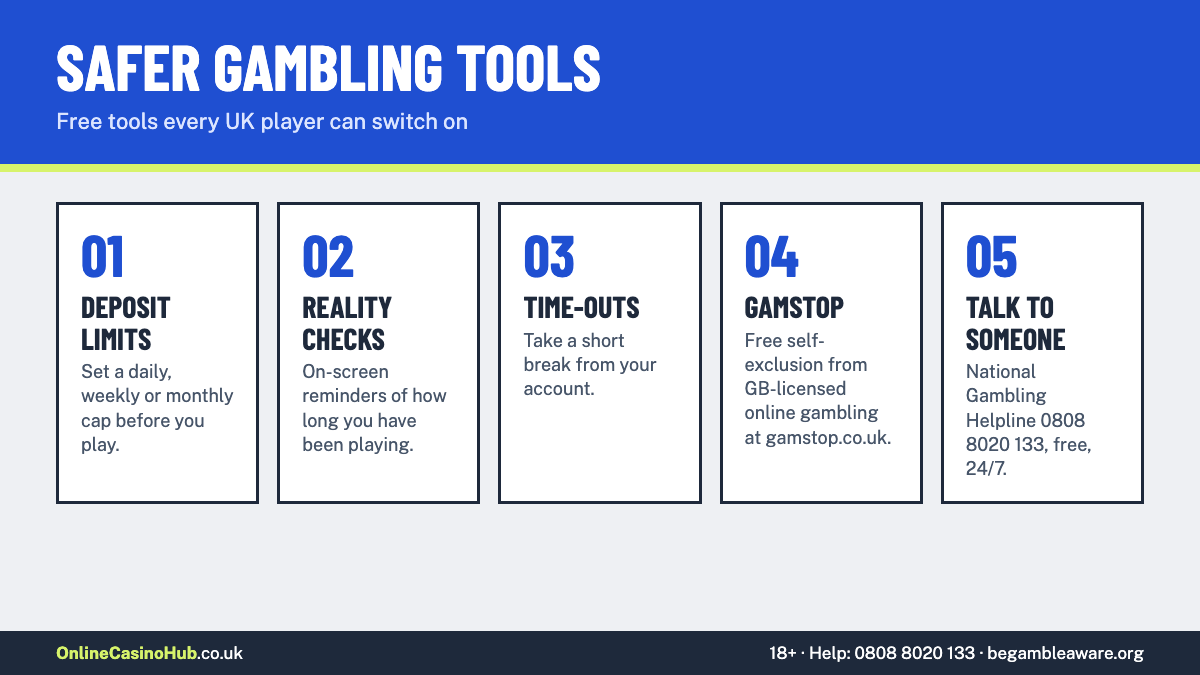
Every GB-licensed casino offers tools to limit how much and how long you play, and you can add free tools that work across all sites. The strongest approach uses several layers at once: a limit at the casino, a block on your device, and GAMSTOP if you want to stop altogether.
| Tool | What it does | Where to set it | Best for |
|---|---|---|---|
| Deposit limit | Caps how much you can pay in over a day, week or month. | Casino account, safer gambling settings | Keeping spending within a budget |
| Loss limit | Caps how much you can lose over a set period, where the casino offers it. | Casino account, safer gambling settings | Stopping a losing session getting worse |
| Reality check | Pop-up showing how long you have played, and often your wins and losses. | Casino account settings | Keeping track of time |
| Time-out | Blocks your account for a short fixed period. | Casino account settings | Taking a break without closing your account |
| Self-exclusion with an operator | Closes your account with that operator for the period you choose. | Casino account or its support team | Stopping with one casino or group |
| GAMSTOP | Blocks your access to accounts on all GB-licensed online gambling sites and apps. | gamstop.co.uk | Stopping online gambling altogether |
| Blocking software | Stops your devices from opening gambling websites and apps. | Your phone, tablet or computer | Adding a barrier to urges |
| Bank gambling block | Stops card payments to gambling businesses, where your bank offers it. | Your banking app | Blocking the money, not just the site |
How do you set a deposit limit?
Go to the responsible or safer gambling section of your casino account and choose a daily, weekly or monthly limit. Set it before your first deposit and pick an amount you can afford to lose. Lowering a limit usually takes effect straight away, while raising one normally involves a waiting period.
A deposit limit is the most useful single tool because it works before you spend, not after. Some tips:
- Set it at registration, when you are thinking clearly, not mid-session.
- Base it on what is left after bills and essentials, not on what you hope to win.
- Use the same limit at every casino you play with, and count them together.
- If you find yourself wanting to raise it often, treat that as a warning sign.
What is a loss limit, and how is it different?
A loss limit caps the amount you can lose over a set period, rather than the amount you can deposit. Not every casino offers one, so check the safer gambling settings in your account. It works well alongside a deposit limit, because winnings you play back can still be lost.
If your casino offers both, set the loss limit at or below your deposit limit. Once you reach it, stop for that period. Do not open an account at another casino to carry on, because that defeats the purpose of the limit.
What are reality checks and time-outs?
A reality check is a pop-up that tells you how long you have been playing, and often how much you have won or lost, at intervals you choose. A time-out blocks your account for a short, fixed period. Both give you a pause to decide whether to keep going.
Reality checks are easy to click past, so set the interval short enough to be useful. A time-out suits a moment when you know you need a break but do not want to close your account. You will find both in your account’s safer gambling settings. During a time-out you cannot log in to play, and you cannot usually cancel it early.
How does self-exclusion work?
Self-exclusion is a longer block that you choose. With one operator, you request it in your account settings and that operator must stop you gambling with it. With GAMSTOP, you register once and are blocked from GB-licensed online gambling sites and apps. Both are free.
When you self-exclude with a casino, it should close your account for the period you choose and stop sending you marketing. When you register with GAMSTOP, you choose an exclusion period from the options it offers; check the current options on gamstop.co.uk. During the exclusion, GB-licensed operators should not let you open or use an account.
Self-exclusion works best as part of a plan. Tell someone you trust, block gambling transactions with your bank if it offers that option, and install gambling blocking software on your phone and computer.
What is gambling blocking software?
Blocking software stops your devices from opening gambling websites and apps. You install it on your phone, tablet or computer, and it runs in the background. It adds a barrier between an urge and a bet, and works alongside GAMSTOP and operator self-exclusion rather than replacing them.
Some tools are free and some are paid. BeGambleAware lists blocking tools on its website. Many UK banks also let you switch on a gambling block for your debit card in their app, which stops payments to gambling businesses. Using several layers at once makes it harder to act on impulse.
What are the signs that gambling is causing harm?
Warning signs include spending more than you planned, chasing losses, borrowing to gamble, hiding gambling from people close to you, and feeling anxious or low about it. If any of these sound familiar, it is worth talking to someone. The National Gambling Helpline is free and confidential.
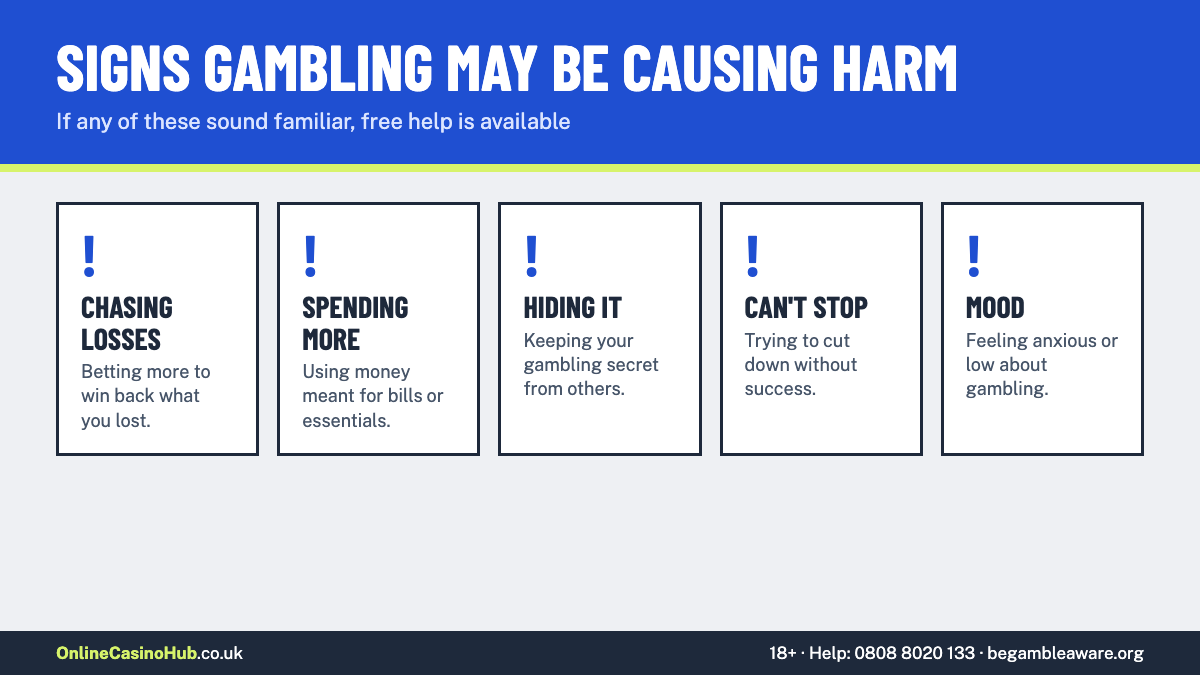
Use this checklist honestly. Tick any that apply to you over the last few months:
| Sign | What it can look like |
|---|---|
| Spending more than planned | Going over your budget or time limit more than once. |
| Chasing losses | Playing on, or raising stakes, to win back money you have lost. |
| Borrowing to gamble | Using loans, overdrafts or money meant for bills. |
| Hiding it | Lying to family or friends about how much you gamble. |
| Restlessness | Feeling irritable or on edge when you try to cut down. |
| Escaping | Gambling to get away from problems or low mood. |
| Neglect | Missing work, family time or sleep because of gambling. |
| Preoccupation | Thinking about gambling a lot when you are not playing. |
One tick does not mean you have a problem, but several, or any that keep coming back, are a reason to act. Set a limit or take a time-out today, and call the helpline for a free, confidential chat.
Credit cards have been banned for gambling in Great Britain since 14 April 2020. If you are looking for ways to gamble with borrowed money, that is a strong sign to stop and seek support.
How can you help someone else who gambles?
If someone close to you is gambling too much, you can get support too. The National Gambling Helpline and BeGambleAware both help affected others, including partners, family and friends. Talking to an adviser can help you plan a conversation, protect your own finances and look after yourself.
Some practical steps:
- Choose a calm moment to talk and focus on how the gambling affects you both.
- Avoid lending money or paying off gambling debts, which can keep the cycle going.
- Protect shared finances, for example by separating accounts where you can.
- Encourage them to call the helpline, and call it yourself for advice.
- Look after your own wellbeing. You are not responsible for their choices.
Signs that someone else may be struggling include unexplained money problems, secrecy about their phone or bank statements, mood swings linked to wins and losses, and asking to borrow money often. You do not need to be certain before asking for advice.
What rules protect players in Great Britain?
Several Gambling Commission rules are designed to reduce harm. You must be 18 or over to gamble online. Online slots are capped at £5 per spin for adults aged 25 and over, and £2 per spin for 18 to 24 year olds. Bonus wagering is capped at 10 times, and mixed-product offers are banned.
| Rule | From |
|---|---|
| Credit card ban for gambling | 14 April 2020 |
| £5 per spin slot limit, adults 25 and over | 9 April 2025 |
| £2 per spin slot limit, adults 18 to 24 | 21 May 2025 |
| Bonus wagering capped at 10x | 19 January 2026 |
| Ban on mixed-product promotions | 19 January 2026 |
These rules apply only to operators licensed in Great Britain. That is one reason we list only casinos with an active UKGC licence, as explained in how we rate casinos.
Why does a bonus need extra care?
A bonus can make you play longer or deposit more than you planned. Before you claim one, check that you would have deposited that amount anyway. Read the wagering, expiry and game rules on the casino’s own page, and keep your deposit limit in place whatever the offer says.
Wagering is capped at 10 times in Great Britain since 19 January 2026, but even 10x means staking far more than the bonus itself. If an offer pushes you to play faster to beat an expiry date, you can skip it. Our casino bonuses guide explains how to read the terms.
How can you keep gambling under control day to day?
Treat gambling as a cost, like a cinema ticket. Decide your budget and time limit before you start, use the casino’s tools to enforce them, and stop when you reach either one. Never gamble when you are upset, drinking, or trying to fix a money problem.
- Only gamble with money you can afford to lose.
- Set a deposit limit and a reality check before you play.
- Take regular breaks away from the screen.
- Do not chase losses by raising your stakes.
- Keep a note of what you spend over a month.
- Balance gambling with other activities you enjoy.
Is gambling a way to make money?
No. Casino games are designed so that the operator keeps an edge over time, which means most players lose more than they win in the long run. Treat any money you gamble as spent on entertainment. If you are gambling to pay bills or clear debts, stop and get free advice.
Some common beliefs make it harder to stop:
- Believing a win is “due” after a run of losses. Each spin or hand is independent.
- Thinking a system or pattern can beat the game over time.
- Counting a near miss as a sign you are close to winning.
- Seeing a bonus as free money. You usually stake your own money first, and wagering applies.
Winnings are generally not taxed for UK players: gov.uk lists betting, lottery or pools winnings among the things you do not pay Capital Gains Tax on. This is not tax advice, and it does not change the basic point that the odds favour the casino.
What if you are worried about debt from gambling?
Be honest about the full amount you owe, including overdrafts, loans and money borrowed from family. Write it down in one place. Seeing the whole picture is often the hardest step, and an adviser can help you deal with creditors and set up a plan you can keep to without gambling.
Stop gambling first, then get advice before you borrow again. The National Gambling Helpline on 0808 8020 133 can talk through your situation and point you to free debt support. Do not use new credit to cover gambling losses, and tell someone you trust what is happening.
What should you do if you want to stop today?
Act while the decision is fresh. Take a time-out or self-exclude with the casino you use, register with GAMSTOP to block GB-licensed sites, switch on a gambling block with your bank if it offers one, and call the National Gambling Helpline on 0808 8020 133 for free support.
- Withdraw any balance you can, then close or self-exclude from the account.
- Register with GAMSTOP at gamstop.co.uk.
- Install blocking software on each device you use.
- Turn on your bank’s gambling block if available.
- Unsubscribe from gambling emails and texts.
- Tell someone you trust, and call the helpline.
If you feel you are losing control at any point, use these steps and call the National Gambling Helpline on 0808 8020 133. It is free and open 24/7.
Your questions, answered
What is the National Gambling Helpline number?
The National Gambling Helpline is 0808 8020 133. It is free, confidential and open 24/7, and is run by GamCare, which also offers live chat and WhatsApp support through gamcare.org.uk.
What does GAMSTOP do?
GAMSTOP is a free self-exclusion service that blocks your access to accounts on GB-licensed gambling websites and apps. You register once and choose an exclusion period from the options shown on gamstop.co.uk.
What is the difference between a time-out and self-exclusion?
A time-out is a short break that blocks your account for a fixed period. Self-exclusion is a longer block you choose, either with one operator or across all GB-licensed sites through GAMSTOP. Both are free and set from your account or the GAMSTOP site.
Can I get help if someone else's gambling affects me?
Yes. The National Gambling Helpline and BeGambleAware support partners, family and friends of people who gamble. An adviser can help you plan a conversation, protect your finances and look after your own wellbeing.
What are the signs gambling is becoming a problem?
Common signs include spending more than you planned, chasing losses, borrowing to gamble, hiding gambling from others and feeling anxious about it. If any sound familiar, call the National Gambling Helpline on 0808 8020 133.
Where our facts come from
- GamCare and the National Gambling Helpline, checked Sep 29, 2026
- BeGambleAware, checked Sep 29, 2026
- GAMSTOP, checked Sep 29, 2026
- Gambling and young people (UKGC), checked Sep 29, 2026
- Gambling on credit cards to be banned from April 2020 (UKGC), checked Sep 29, 2026
- Online slots stake limit guidance (UKGC), checked Sep 29, 2026
- Statutory levy and online slot stake limits to be introduced (gov.uk), checked Sep 29, 2026
- Gambling promotions to be safer and simpler (UKGC), checked Sep 29, 2026
- Capital Gains Tax: what you pay it on (gov.uk), checked Sep 29, 2026